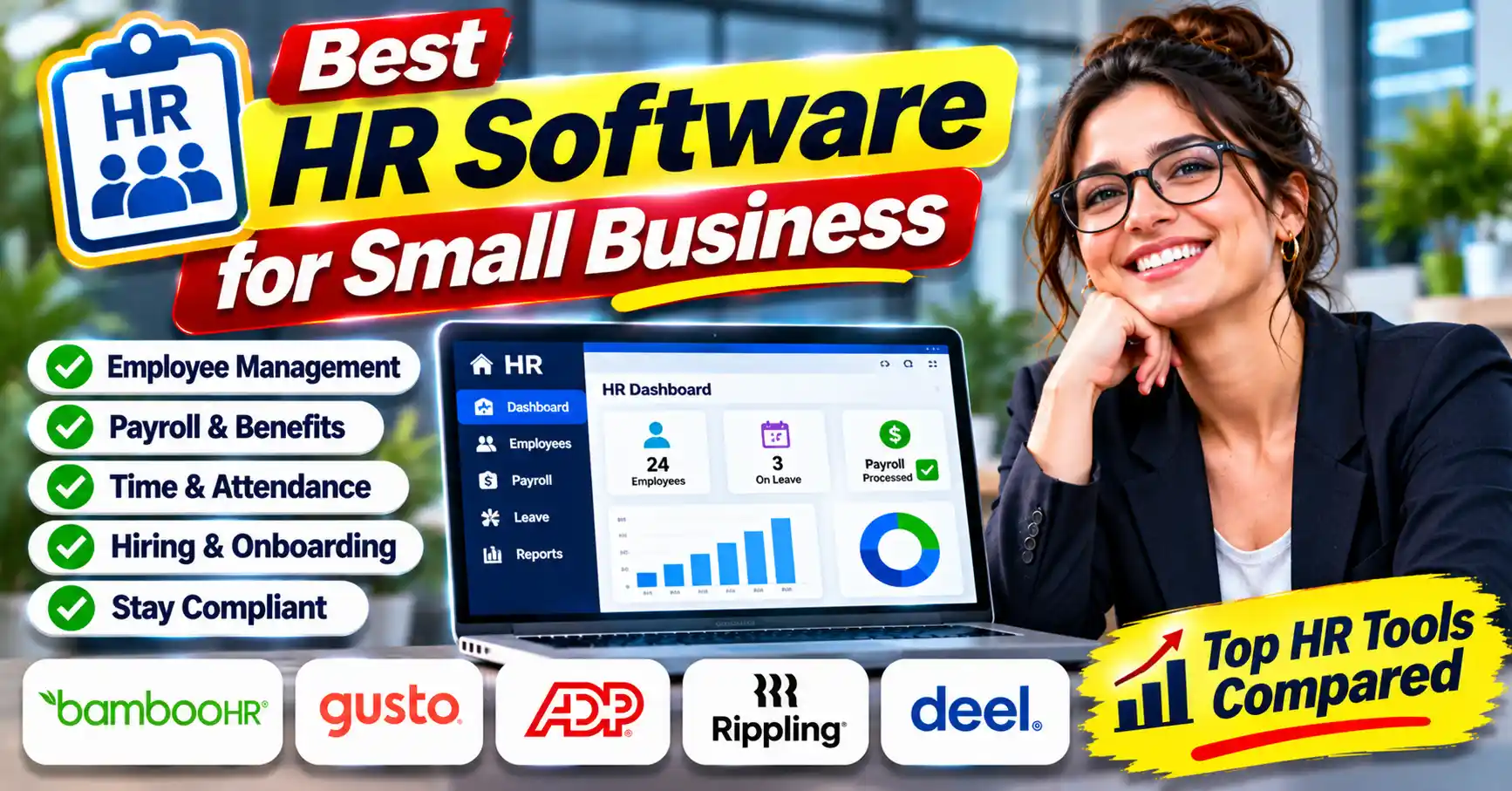
Finding the right HR software for small business operations requires looking past basic starting prices to calculate true per-employee scaling costs. In 2026, the most competitive small business HR software averages a $35–$40 monthly base fee plus $4–$8 per employee. Top US options like Gusto, Rippling, and ADP RUN automate state-level tax filings and labor compliance, preventing costly IRS penalties while streamlining payroll.
Key Takeaways
- The Base + PEPM Math: Most 2026 HR software contracts utilize a hybrid pricing structure averaging a $39 base fee plus a $6 “Per-Employee, Per-Month” (PEPM) charge for core payroll and time tracking.
- Automated US Compliance: The top-rated platforms proactively sync with 2026 IRS tax brackets, federal FLSA overtime thresholds, and state-specific mandates (such as California’s meal break laws or New York’s Paid Family Leave).
- HRIS vs. PEO Delineation: Pure software systems allow you to bring your own benefits broker, whereas Professional Employer Organizations (PEOs) co-employ your staff to provide national health insurance access for a higher admin fee (typically $59–$99/employee).
- Hidden Implementation Costs: Depending on the provider, migrating historical W-4s, I-9s, and payroll data from legacy systems can take 2 to 4 weeks and may incur one-time setup fees ranging from $0 to $500+.
At-a-Glance 2026 Benchmark Summary
| Provider / Option | Best For | 2026 Avg. Rate / Threshold | Standout Rule or Rating |
|---|---|---|---|
| Gusto | Startups & micro-businesses wanting automated multi-state tax filing | $40/mo base + $6/employee/mo | 4.4/5 Capterra; fully automated local/state tax remittance |
| Rippling | Tech-forward firms needing joint IT provisioning and HR | $35/mo base + $8/employee/mo | 4.8/5 G2; unified employee data across 500+ app integrations |
| BambooHR | Mid-size teams (50–250) prioritizing performance & culture | ~$8–$12/employee/mo (Custom) | No base fee typically; premium focus on talent management |
| ADP RUN | Traditional businesses wanting highly scalable, payroll-first HR | ~$79/mo base + $4/employee/mo | A+ BBB rating; robust 24/7 IRS/state agency dispute support |
| Paychex Flex | Blue-collar/service businesses needing hands-on compliance | $39/mo base + $5/employee/mo | Strong local rep network & dedicated workers’ comp integrations |
| Justworks (PEO) | Remote teams seeking premium national health benefits | $59/employee/mo (Admin fee) | Requires joining a co-employment tax ID; transparent tier pricing |
How HR and Payroll Software Works & What Determines Your Costs
At its core, modern HR and payroll software functions as a centralized compliance and calculation engine. Instead of manually calculating state income tax, Federal Insurance Contributions Act (FICA) withholdings, and Medicare, the software cross-references your employees’ W-4 data with live regulatory tax brackets. An effective employee management software automatically deducts the correct amounts, pays the workforce via direct deposit, and remits the exact tax liabilities to the IRS and respective state agencies on your behalf.
Your total software costs are primarily driven by three variables:
- The Base Fee: A fixed monthly subscription cost (typically $35 to $79) to access the platform.
- The PEPM (Per-Employee, Per-Month) Fee: A variable rate multiplied by your active headcount.
- Module Add-Ons: Optional features like time tracking, benefits administration, or advanced performance review modules that increase the base or PEPM rate.
2026 Market Comparison: Top US Platforms Analyzed
When evaluating the best HR platforms for small business, it is crucial to match the provider’s architectural strength with your company’s actual operational needs. Here is a breakdown of how the real market leaders operate in 2026.
Gusto: Best For Startups & Micro-Businesses
Gusto remains the benchmark for businesses under 50 employees due to its highly automated, user-friendly tax remittance engine. It automatically files local, state, and federal taxes across all 50 states without requiring a premium add-on. However, as companies scale past 100 employees, some find its custom reporting and enterprise permissions lacking compared to mid-market systems.
Rippling: Best For Tech-Forward Companies
Rippling operates on a unified employee graph, meaning it merges HR with IT provisioning. When a new hire is added to the payroll, Rippling can simultaneously order their laptop, provision their Google Workspace accounts, and manage their software access. It is highly efficient for remote, white-collar teams, though the base pricing can escalate quickly when adding non-HR IT modules.
BambooHR: Best For Mid-Size Teams (50–250)
Unlike payroll-first platforms, BambooHR focuses deeply on the employee lifecycle—culture, performance management, and applicant tracking. It does not charge a standard base fee, opting instead for custom PEPM quotes. While it requires an integration or a separate add-on to run actual payroll, its core strength lies in tracking employee satisfaction and automating reviews.
ADP RUN: Best For Traditional Scalability
ADP RUN is designed specifically for small businesses but is backed by the largest payroll processor in the US. Its major advantage is regulatory defense; ADP has established, direct integrations with state tax agencies and offers robust compliance support. Its user interface is less intuitive than Gusto’s, and billing can be opaque, often relying on negotiated tier pricing rather than flat public rates.
Paychex Flex: Best For Service & Blue-Collar Sectors
Paychex excels in environments with complex hourly scheduling, varied shift differentials, and high workers’ compensation risks. They offer localized compliance support and tight integration with insurance brokers. The downside is that premium support often requires upgrading tiers, and some a la carte features drive up the final monthly invoice.
Justworks (PEO): Best For Premium Benefits Access
Justworks is not standard software; it is a Professional Employer Organization (PEO). By joining Justworks, your employees are co-employed under their master tax ID. This grants a 15-person business access to Fortune 500-level health insurance rates. The trade-off is a significantly higher administrative fee (starting around $59 per employee, plus the actual cost of insurance premiums).
Average Costs & True Pricing by Team Size (2026 Benchmarks)
Finding truly affordable HR software requires forecasting your headcount. The software industry heavily relies on the “Total Cost of Ownership” (TCO), which compounds as you hire. If you are specifically looking for basic small business payroll software, your cost curve will look drastically different than a company buying a full HR suite.
2026 Estimated Monthly Cost Breakdown by Consumer Profile
| Platform Tier | 10 Employees (Micro-Business) | 50 Employees (Scaling Small Business) | Standout Cost Factor |
| Entry-Level Payroll Only (e.g., Gusto Simple) | $40 Base + $60 ($100/mo) | $40 Base + $300 ($340/mo) | Lowest upfront cost; limited HR support. |
| Mid-Tier HR Suite (e.g., Rippling Core) | $35 Base + $80 ($115/mo) | $35 Base + $400 ($435/mo) | Costs compound if IT modules are added. |
| Legacy Negotiated (e.g., ADP RUN) | ~$79 Base + $40 ($119/mo) | ~$79 Base + $200 ($279/mo) | Heavy reliance on negotiated discounts. |
| PEO Model (e.g., Justworks) | $0 Base + $590 ($590/mo) | $0 Base + $2,950 ($2,950/mo) | High admin fee offsets lower health insurance premiums. |
Concrete Consumer Math Example: Consider a 15-person plumbing business in Texas evaluating a mid-tier plan priced at $40/month base + $8/employee/month. The monthly software cost is $160 ($1,920 annually). However, if the business owner selects a 401(k) integration add-on at $39/month and workers’ comp administration at $5/employee/month, the actual monthly bill balloons to $274 ($3,288 annually). Businesses must budget for these modular add-ons rather than relying solely on the advertised base price.
Step-by-Step Guide: How to Evaluate & Implement Safely
Migrating your company’s sensitive data into a new HRIS software for small business is a high-risk transition. Rushing the process can result in delayed direct deposits or mismatched W-2s.
- Audit Your Current Workflows: Document your exact payroll schedule, state tax IDs, overtime rules, and paid time off (PTO) accrual formulas.
- Require a Sandbox Demo: Never buy software off a sales deck. Require the vendor to run a mock payroll run using your specific state’s tax codes to ensure the system handles your deductions correctly.
- Evaluate the Employee Experience: The best employee onboarding software allows new hires to self-onboard, digitally sign I-9s, and enter their own direct deposit information before their first day. Ensure the mobile app is intuitive.
- Plan a Parallel Payroll Run: During your first month of implementation, run payroll on your old system and the new system simultaneously to ensure the net pay and tax withholding numbers match to the penny.
Key Pros, Cons & Trade-Offs Small Businesses Must Know
Investing in all-in-one HR software consolidates data but creates a single point of failure.
Pros:
- Data Integrity: Employee data flows seamlessly from onboarding to payroll to benefits administration without manual double-entry.
- Compliance Insulation: Automated updates to federal/state labor laws reduce the risk of audit penalties.
- Operational Efficiency: Self-service portals free up business owners from manually answering PTO balance questions or reprinting pay stubs.
Cons:
- Vendor Lock-In: Once your payroll, benefits, and IT are centralized, switching providers becomes an expensive, multi-month logistical nightmare.
- Support Bottlenecks: Rapidly growing software companies often route support tickets to overseas call centers, making it difficult to resolve urgent, time-sensitive payroll errors on payday.
Read this Also : Dental Insurance for Seniors in 2026 : Guide
Frequently Asked Questions
Do I need HR software if I have fewer than 5 employees?
Yes. Even with a single W-2 employee, you must calculate precise state and federal withholdings, file new hire reports, and remit quarterly payroll taxes. Software automates this exact federal and state compliance for roughly $45 a month, which is significantly cheaper than minimum IRS failure-to-file penalties.
What is the difference between a PEO and standard HR software?
The core difference is the legal co-employment structure. A PEO (like Justworks) legally employs your workers under its master tax ID to provide Fortune 500-level health insurance, whereas standard HR software (like Gusto or BambooHR) leaves you as the sole employer and requires you to bring your own benefits broker.
How much does small business payroll software actually cost in 2026?
The 2026 national benchmark is a $35 to $40 monthly base fee plus $4 to $8 per employee per month. For a standard 10-person company, expect a baseline cost of $75 to $120 monthly for core payroll, direct deposit, and automated tax compliance.
Does HR software file my state and federal taxes automatically?
Yes, top-tier platforms will automatically calculate, deduct, and remit all local, state, and federal taxes on your behalf. However, you remain legally responsible for ensuring your workers are correctly classified as W-2 employees or 1099 contractors before the system processes the numbers.
Can I switch HR platforms in the middle of the tax year?
Yes, but it requires meticulous historical data entry. You must import all year-to-date (YTD) payroll totals for every employee so the new system accurately issues consolidated W-2s at year-end without restarting tax bracket calculations.
Final Expert Educational Summary
When I audit compliance systems and payroll setups for growing companies, I always remind founders that selecting the right hr software for small business is less about the user interface and more about matching the system architecture to your specific workforce profile.
If you are a startup or micro-business looking for automated, hands-off tax compliance across multiple states, Gusto is currently the most mathematically sound and user-friendly choice. If your team is remote and heavily reliant on hardware provisioning and app access, Rippling’s unified IT and HR approach will save you dozens of administrative hours per month. Finally, if you need to offer premium national health insurance to compete for top talent, paying the higher administrative fees for a PEO like Justworks is often worth the investment trade-off.
Do not let introductory pricing obscure your true scaling costs. Always map out your projected per-employee, per-month (PEPM) fees for the next 12 months, and demand a sandbox demo using your state’s specific labor codes before committing your employee data to a new platform.
1 thought on “Best HR Software for Small Business: 2026 Costs & Ratings”